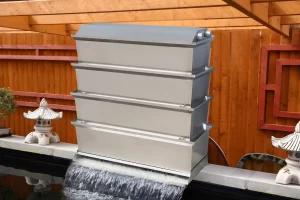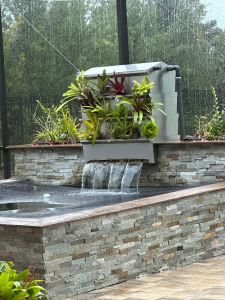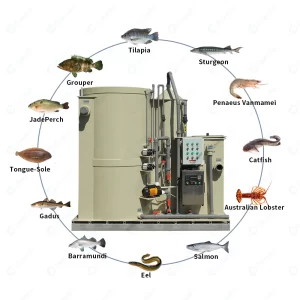
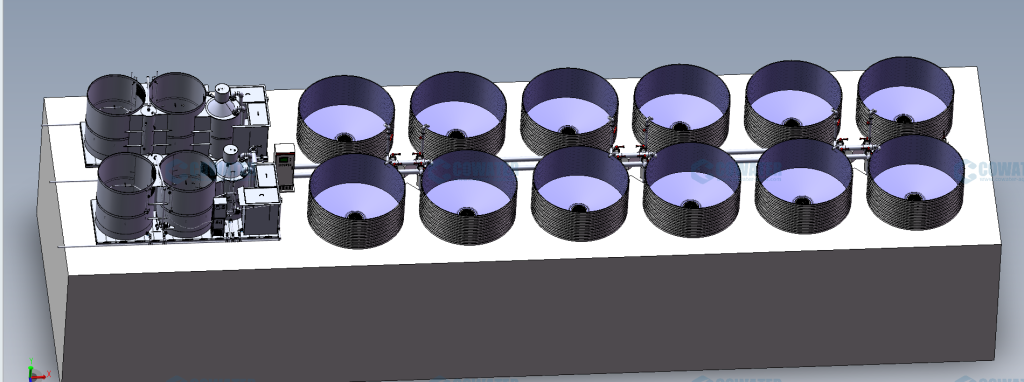
Twelve circular tanks, two integrated recirculating aquaculture systems, and a complete water-treatment train built around one objective: maintaining a stable environment for tilapia while keeping the water in continuous circulation. This was the configuration delivered for a tilapia farming project in France. The farm includes 12 fish tanks, each 4 m in diameter and 1.45 m high. Based on the stated dimensions, the total geometric tank volume is approximately 219 m³, before accounting for operating water level, freeboard and equipment pipework. To support this scale, the project uses two CW-RAS-60 integrated systems rather than relying on a single treatment line.
In a recirculating farm, tank volume is only the visible part of the project. The real challenge is keeping solids, dissolved organics, ammonia, pathogens and dissolved oxygen under control at the same time. Fish continuously add waste to the water, uneaten feed increases the organic load, and biological filtration needs a stable environment to convert toxic ammonia into less harmful nitrogen compounds. If one part of the loop is undersized or poorly coordinated, the problem moves downstream instead of disappearing: solids burden the biofilter, organics reduce water quality, and insufficient oxygen limits both fish performance and nitrifying bacteria. For 12 tanks, the filtration system therefore has to be designed as one hydraulic and biological process rather than as a collection of isolated machines.
The solution for this French project is two CW-RAS-60 units working as the core of the farm’s water-treatment infrastructure. Splitting the treatment capacity between two units creates a more manageable layout and provides operational flexibility. Each unit can serve its assigned circulation zone, while the overall installation benefits from a modular structure that is easier to inspect, maintain and expand than one oversized, centralized arrangement. The final configuration is based on the tank layout, stocking plan, target turnover and water-quality requirements, so the system can be commissioned around the actual farm conditions rather than a generic equipment list.
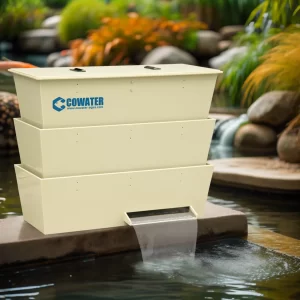
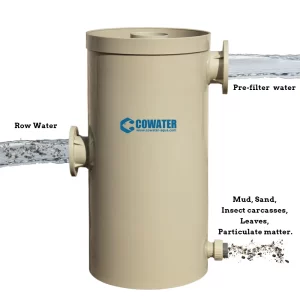
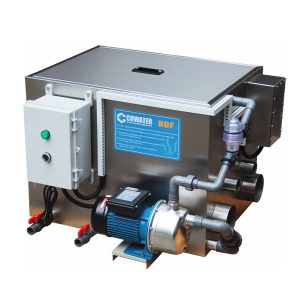
The equipment package covers the key stages of RAS treatment. A flow sedimentation unit helps separate heavier solids from the water at the beginning of the process, reducing the load that reaches the finer filtration stages. The microfilter then captures smaller suspended particles, helping prevent solids from breaking down into additional dissolved pollution. UV disinfection provides continuous control of waterborne microorganisms, while circulation pumps keep the treatment loop moving. The protein skimmer, combined with an ozone generator, targets dissolved organic matter and fine impurities that mechanical filtration alone cannot remove. This combination helps keep the water clearer and reduces the organic pressure placed on the biological stage.
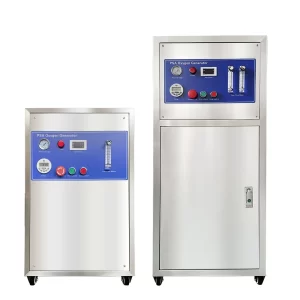
Biological filtration is the heart of the system. The biofilter provides the environment for nitrifying bacteria, while the integrated K5 media offers a large protected surface for biological colonization. As the system matures, these microorganisms convert ammonia generated by the fish into nitrite and then nitrate, creating the basic water-quality cycle required for stable tilapia production. The blower supports the biological process by supplying air, while the oxygen cone and oxygen generator provide a dedicated solution for maintaining dissolved oxygen. This is important not only for the fish but also for the biofilter, because both the stock and the nitrifying bacteria depend on a reliable oxygen supply.
Control is another major part of the project. Instead of asking operators to monitor every individual component manually, the two systems are connected to a PLC central control cabinet. The control architecture brings pumps, disinfection, aeration, oxygen supply and other operating functions into one management point, making it easier to monitor system status, coordinate operation and respond to alarms. In a commercial farm, this matters because stable water quality is not achieved by a single treatment step; it is achieved by keeping the entire loop running in the right conditions, every day.
The result of this configuration is a complete, integrated RAS solution for the French tilapia farm. Solids are removed before they can accumulate, dissolved organics are treated, biological filtration supports ammonia conversion, UV and ozone strengthen water-quality management, and oxygen equipment supports both fish health and biofilter activity. With two CW-RAS-60 units serving the 12-tank layout, the farm gains a modular treatment structure that is easier to operate and maintain. Most importantly, the system reduces dependence on continuous water exchange and turns water quality into a controlled engineering process rather than a daily reaction to problems.
This project reflects the advantage of working with a supplier that can integrate the whole RAS loop. We do not treat the microfilter, protein skimmer, biofilter, UV unit, oxygen system and control cabinet as unrelated products. We match them to the tank layout, biological load and operating objectives, then bring them together as one coordinated solution. From equipment selection and system integration to control design and commissioning support, our goal is to deliver a recirculating aquaculture system that can run reliably over the long term. For your next tilapia, fish-farming or RAS project, share your tank dimensions, species and target production plan with us. We will size the system around the farm — not the other way around.