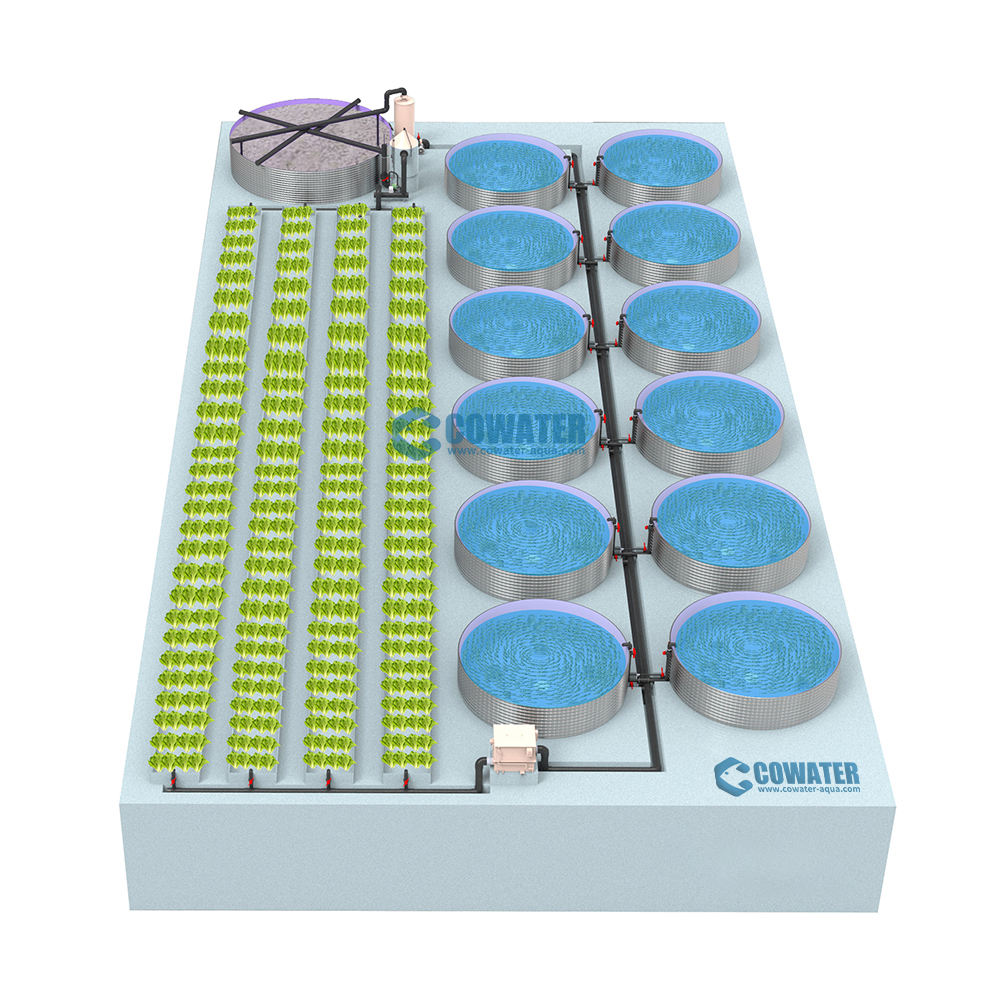
Twelve round fish tanks and four long grow beds, running as a single recirculating loop, with red tilapia in the water and lettuce on top of it. That is the system we designed and delivered for a client in Iraq: 12 circular tanks at 6 m diameter and 1.45 m depth, holding roughly 490 m³ of rearing water, feeding four plant troughs of 40 m by 1.6 m at 0.5 m depth — about 256 m² of growing surface and 128 m³ of bed volume. Add it up and the site runs close to 620 m³ of water that never leaves the site.
The reason the brief looked like this is the climate. Iraq’s summers are brutal on open water: intense sun, high evaporation, scarce and increasingly expensive supply, and dust that settles into everything. Warm water also holds less oxygen while ammonia becomes more toxic at higher temperature and pH — precisely the combination that makes conventional pond culture dependent on constant exchange. Pumping fresh water to keep a pond alive is not a strategy in a country where water is the constraint. So the requirement was never “build a pond”. It was: keep the water, hold the oxygen, and get two products out of the same volume.
That is what aquaponics does. Ammonia excreted by the fish is not a waste stream to be flushed; it is the feedstock for the plants. Nitrifying bacteria convert it to nitrate, the lettuce takes the nitrate up, and the water returns to the tanks cleaner than it left. The engineering question is whether the loop can be held in balance — and balance is set by sizing.
We sized from the load rather than from a catalog. The 12 tanks are round, which lets solids concentrate toward the centre drain and keeps flow even across the wall, with no dead corners. The 40 m troughs at 0.5 m depth match the lettuce root zone while keeping the beds shallow enough to stay oxygenated and workable. Tank volume was balanced against loop turnover, and plant surface was matched to the daily ammonia production of the stocked biomass, so the beds remove what the fish actually generate rather than what a table in a brochure says they should.
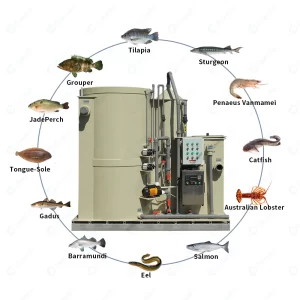
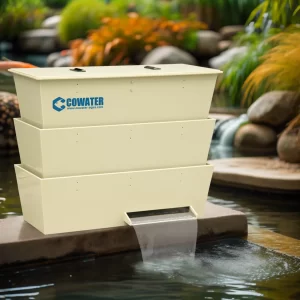
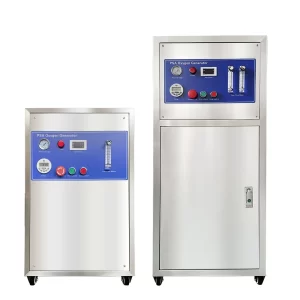
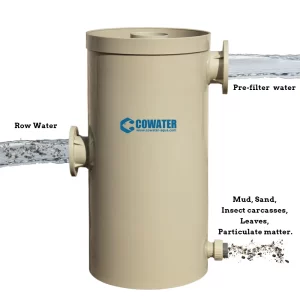
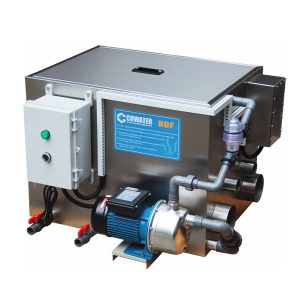
Between tanks and beds sits the treatment train, and the sequence matters as much as the equipment. A drum microfilter takes out settleable and suspended solids before they can dissolve and load the water — this is the step that keeps everything downstream from working overtime. A protein skimmer strips dissolved organics and the fine particles a screen cannot catch, which is what keeps foam, odour and bacterial load down in a warm system. A biological filter carries the nitrifying population that turns ammonia into nitrite and then nitrate — the conversion the plants depend on. A UV sterilizer holds pathogens and free-floating algae in check in water that is being continuously recycled, and an oxygen system keeps dissolved oxygen where both the fish and the root zone need it. Solids first, dissolved organics second, biology third, disinfection and oxygenation last, so nothing removed upstream is undone further down the line.
The results are structural rather than cosmetic. Water stays in the loop, so the only routine loss is what evaporates and what the plants transpire — consumption drops from exchange volumes to top-up volumes, which is the whole economic argument in a water-scarce market. Water quality holds through the hot season because biofiltration and oxygenation are continuously supported instead of being patched when fish start gasping. One water body yields two saleable products, fish and greens, on overlapping cycles, which spreads risk across two markets rather than one. Effluent is no longer something to dispose of: solids captured by the drum filter leave as sludge, and the nutrient-rich water that used to be dumped becomes the irrigation and fertigation stream for the beds. And the operation stops depending on a supply that may not arrive.
What we bring to a project like this is the whole loop from one place. Mechanical filtration, biological treatment, disinfection and oxygenation are designed as a single hydraulic and biological system, not four boxes bolted together and commissioned separately — because in aquaponics the failure mode is almost never one bad component, it is a mismatch between components. We also size to the site: a system for Iraqi summer heat, dust and variable supply is not the same system we would ship to a temperate climate, and pretending otherwise is how aquaponics projects fail in year one.
If you are planning a recirculating fish or aquaponics project, send us your tank volumes, target species and local climate. We will size the loop first, then quote the equipment.